Algebraic Equations - word problems
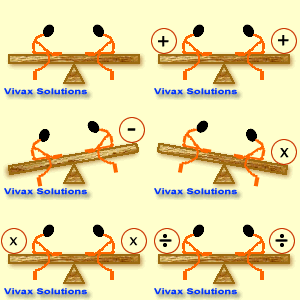
An equation is almost a sort of seesaw: you add something to the left, lose the balance and are forced to do the same to the right; you divide and multiply by something, once again,
the same must be done to the other side; if you subtract something, there is no exception. Therefore, solving equation means, getting rid of everything around x by seesaw method.
E.g.1
I think of a number, add 7 and the answer is 10. Find the number.
Let the number be x.
x + 7 = 10
-7 => x + 7 -7 = 10 -7
x = 3
The number is 3.
E.g.2
I think of a number, take away 5 and the answer is 10. Find the number.
Let the number be x.
x - 5 = 10
+ 5 => x -5 + 5 = 10 + 5
x = 15
The number is 15.
E.g.3
I think of a number, multiply by 3 and the answer is 30. Find the number.
Let the number be x.
3x = 30
:- 3 => 3x / 3= 30 /3
x = 10
The number is 10.
E.g.4
I think of a number, multiply it by 2, take away 4. The answer is 10. Find the number.
Let the number be x.
2x - 4 = 10
+ 4 => 2x - 4 + 4 = 10 + 4
2x = 14
:- 2 => 2x / 2 = 14 / 2
x = 7
The number is 7.
E.g.5
I think of a number, divide by three, add 7. The answer is 10. Find the number.
Let the number be x.
x/3 + 7 = 10
-7 => x/3 + 7 - 7 = 10 - 7
x/3 = 3
X 3 => x/3 X 3 = 3 X 3
x = 9
The number is 9.
Algebra Equation Generator
You can generate as many questions as you want with the following programme, along with the answers. First generate the question, then work them out and check with the answer.
E.g.6
I think of a number, take away three and then divide by 4. The answer is 3. Find the number.
Let the number be x.
(x - 3) / 4 = 3
X 4 => (x-3) /4 X 4 = 3 X 4
(x-3) = 12
+ 3 => x - 3 + 3 = 12 + 3
x = 15
The number is 15.
E.g.7
I think of a number, multiply by 3, add 3. The answer is the same, if I add 10 to the number. Find the number.
Let the number be x.
3x + 3 = x + 10
-3 => 3x + 3 -3 =x + 10 - 3
3x = x + 7
- x => 3x - x = x - x + 7
2x = 7
:-2 => 2x / 2 = 7 / 2
x = 3.5
The number is 3.5.
E.g.8
I think of a number, multiply by 2, take away 4. The answer is the same if I multiply it by 5 and then add 8. Find the number.
Let the number be x.
2x - 4 = 5x + 8
+4 => 2x - 4 + 4 = 5x + 8 + 4
2x = 5x + 12
-5x => 2x - 5x = 5x - 5x + 12
-3x = 12
:--3 => -3x/-3 = 12 / -3
x = -4
The number is -4.
E.g.9
The width of a rectangle is 2cm less than the length. The perimeter is 20 cm. Find the length and the area.
let the width be x. So, the length = x + 2.
x + x + 2 + x + x + 2 = 20
4x + 4 = 18
-4 => 4x + 4 - 4 = 20 - 4
4x = 16
:-4 => 4x / 4 = 16 / 4
x = 4
Width = 4cm; length = 6cm;
Area = 24 cm2.
E.g.10
The sum of two consecutive odd numbers is 52. Find the numbers.
Let the first number be x. Then the next one is x + 2.
x + x + 2 = 52
2x + 2 = 52
-2 => 2x + 2 - 2 = 52 - 2
2x = 50
:-2 => 2x / 2 = 50 / 2
x = 25
The numbers are 25 and 27.
E.g.11
Divide 24 into two numbers so that the ratio of their sum to difference is 3: 2.
Let the first number be x. Then the next one is 24 - x.
Difference = 24 - x - x = 24 - 2x
24 : 24 - 2x = 3 : 2
48 = 72 - 6x
6x = 24
:-6 => 6x / 6 = 24 / 6
x = 4
The numbers are 20 and 4.
E.g.12
The weights of two sacks of sugar are in the ratio 4 : 5. If 3kg is taken from the first and put into the second, the latter is twice as heavy as the former. What is the weight of each?
Let the weights be 4x and 5x respectively.
After the removal of 3kg from the first, the weights are 4x - 3 and 5x + 3 respectively.
2(4x - 3) = 5x + 3
8x - 6 = 5x + 3
3x = 9
:3 => 3x / 3 = 9 / 3
x = 3
The weights of the sugar sacks are 12kg and 15kg respectively.
Ad: LED Night Light from Amazon
- ✔ Smart Bedside Table Lamp
- ✔ Touch Control
- ✔ Dimmable
- ✔ USB Rechargeable
- ✔ Portable
- ✔ Colour Changing RGB for Kids Bedroom
- ✔ Camping (Warm White)
🏆 Challenging Question of the Day

You will get a challenging random question here everyday; challenging means, really challenging. Make sure you watch this space everyday for it.
Ad: The author's fully interactive tutorial on differentiation
♥ An Incentive for the hard working...
Finding the square root of a number without a calculator
E.g. 1 √324 = √4 x 81 = √2² x 9² = √2² x 3² x 3² = 2 x 3 x 3 = 18
E.g. 2 √441 = √9 x 49 = √3² x 7² = 3 x 7 = 21
Now try with √144 and √1225, for fun.
Practice Questions
Now, in order to complement what you have just learnt, work out the following questions:
- I think of a number, multiply by 4 and add 5. The answer is 29. Find the
number.
- I think of a number, add 3 and the result is multiplied
by 4. The answer is 28. Find the number.
- I think of a number, add 6 and divide by 3. The answer is 5. Find the
number.
- I think of a number, multiply by 4, and add 6. The result is then multiplied by 5
and the answer is 70. Find the number.
- Twice a number added to 5 is the same as the number added to 10. Find the
number.
- A number multiplied by 5, add 4 is the same as 6 times the number. Find the
number.
- Three times a number, add nine, divided by 6 is the same as the number itself. Find
the number.
- Twice a number added to 6 is the same as ten subtracted from six times the number.
Find the number.
- The sum of three consecutive numbers is 78. Find the numbers.
- The sum of three consecutive even numbers is 60. Find the numbers.
- The sum of the half, the third and the forth of a number is 10 more than the original number. Find the number.
- The sixth of a number exceeds the eight of the same number by 4. Find the number.
- Divide £110 among Amy, Basil and Clare in such a way that Amy has £10 more than Basil and Basil has £20 more than Clare.
- Find a number so that its half exceeds the sum of the fifth and the sixth of the same by 16.
- A man is twice old as his son is now. Eighteen years ago, he was 5 times as old as his son was then. How old is his son now?
- in order to convert Celsius temperature into that of Fahrenheit, multiply the former by (9/5) and add 32. At what temperature, will both scales show the same value?
- Anil and Bimal shared £80 between them. When Bimal gives Anil £20, Anil has £12 more than Bimal. How much did then have at the beginning?
- The sum of two numbers is 112. Find the numbers, if the difference between them is 48.
- Find two numbers with a difference and a mean, 8 each.
- The longest side of an isosceles triangle is 4cm more than the twice of each other side. Find the length of the longest side, if the perimeter is 44cm.
Answers
Move the mouse over, just below this, to see the answers:
- 6
- 4
- 9
- 2
- 5
- 4
- 3
- 4
- 25, 26, 27
- 18, 20, 22
- 120
- 96
- 50, 40, 20
- 120
- 24
- -400
- 26, 54
- 80, 32
- 12, 4
- 24
Do you need detailed solutions for the above challenges? Please click the following and I will send the answers:
Detailed Solutions
for
Algebra Challenges
As a PDF
for Just £3.00
Now that you have read this tutorial, you will find the following tutorials very helpful too: